
Pemanfaatan Karbon Aktif dari Limbah Kulit Pisang Kepok (Musa Paradisiaca L) sebagai Elektroda Superkapasitor
Article Sidebar
Main Article Content
Abstract
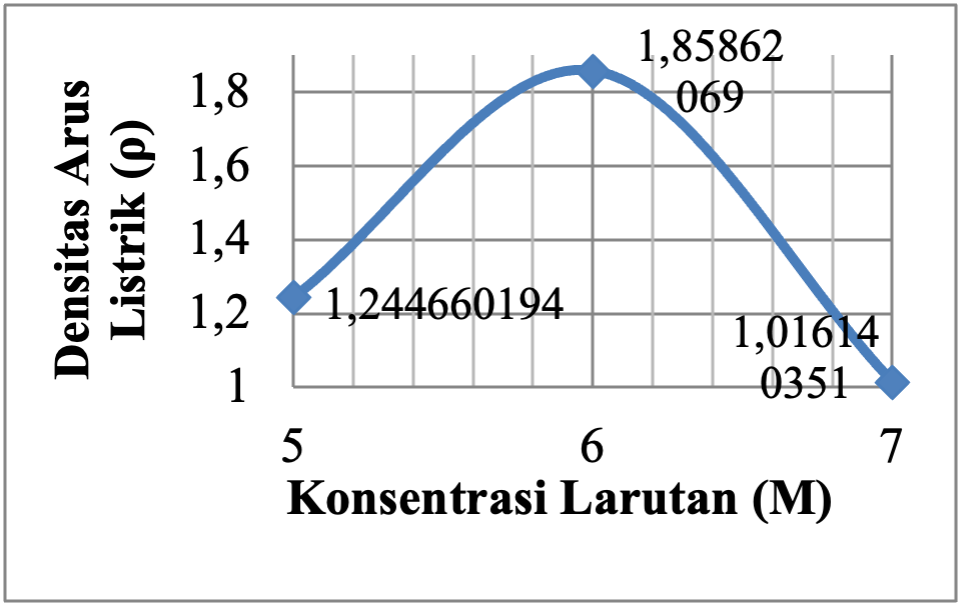
In recent years, attention to renewable energy has increased, especially in electrical energy. One of the emerging technologies in supporting electrical energy storage is supercapacitors. This study aims to determine the effect of variations in the concentration of KOH solution on the current and voltage characteristics produced by supercapacitor electrodes made from activated carbon from kepok banana peel waste (Musa Paradisiaca L). By using dehydration method 80°C, carbonization at 400°C, chemical activation with 5M, 6M, and 7M KOH solution, and physical activation at 750°C. The results showed that the concentration of KOH activator from 5M, 6M, to 7M increased the electric voltage to 0.641 V, 1.078 V, and 1.448 V and electric current to 10.3 mA, 11.6 mA, and 28.5 mA, respectively. However, the density and conductivity values showed different patterns, with density values of 1.2446 A/
Article Details
References
Aulia, R., Juliasih, N. L. G. R., & Rinawati, R. (2018). Pembuatan dan karakterisasi karbon aktif Dari kulit pisang kepok (musa paradisiaca l.) Sebagai adsorben Senyawa polisiklik aromatik hidrokarbon fenantrena. Analit: Analytical and Environmental Chemistry, 3(02), 126–138. https://doi.org/10.23960/aec.v3.i2.2018.p126-138
Avni, Y., Adar, R. M., Andelman, D., & Orland, H. (2022). Conductivity of Concentrated Electrolytes. Physical Review Letters, 128(9). https://doi.org/10.1103/PhysRevLett.128.098002
Farma, R. … Yanuar, H. (2018). Cyclic Voltammetry Sel Superkapasitor Dengan Variasi Konsentrasi Aktivator Kalium Hidroksida. Jurnal Fisika Indonesia, 21(2), 20. https://doi.org/10.22146/jfi.42203
Forouzandeh, P., Kumaravel, V., & Pillai, S. C. (2020). Electrode materials for supercapacitors: A review of recent advances. Catalysts, 10(9), 1–73. https://doi.org/10.3390/catal10090969
Gautham Prasad, G. … Bommegowda, K. B. (2019). Supercapacitor technology and its applications: A review. IOP Conference Series: Materials Science and Engineering, 561(1). https://doi.org/10.1088/1757-899X/561/1/012105
Huda, A. N., Lestari, I., & Hidayat, S. (2022). Pemanfaatan Karbon Aktif dari Sekam Padi Sebagai Elektroda Superkapasitor. Jurnal Ilmu Dan Inovasi Fisika, 6(2), 102–113. https://doi.org/10.24198/jiif.v6i2.39639
Imelda, D., Khanza, A., & Wulandari, D. (2019). Pengaruh Ukuran Partikel Dan Suhu Terhadap Penyerapan Logam Tembaga ( Cu ) Dengan Arang Aktif Dari Kulit Pisang Kepok ( Musa Paradisiaca Formatypica ). Jurnal Teknologi, 6(2), 107–118.
Kimbal, A. J. … Pawarangan, I. (2025). KELAPA DENGAN VARIASI KONSENTRASI KOH SEBAGAI MATERIAL ELEKTRODA SUPERKAPASITOR CHARACTERISTICS OF ACTIVATED CARBON BASED ON COCONUT FROND WASTE WITH VARIATIONS OF KOH CONCENTRATION AS SUPERCAPACITOR ELECTRODE MATERIAL. 8(1), 4–10.
Mahyuda, M., Sirait, R., & Lubis, R. Y. (2024). Pengaruh Konsentrasi KOH Terhadap Karakteristik Dan Kapasitansi Elektroda Karbon Aktif Super Kapasitor. Jurnal Rekayasa Material, Manufaktur Dan Energi, 7(2), 207–213. http://jurnal.umsu.ac.id/index.php/RMMECC-BY-SAlisence%0Ahttps://creativecommons.org/licenses/by-sa/4.0/
Maia, L. S., Duizit, L. D., Pinhatio, F. R., & Mulinari, D. R. (2021). Valuation of banana peel waste for producing activated carbon via NaOH and pyrolysis for methylene blue removal. Carbon Letters, 31(4), 749–762. https://doi.org/10.1007/s42823-021-00226-5
Masriatini, R. (2017). Pembuatan Karbon Aktif Dari Kulit Pisang. Gastronomía Ecuatoriana y Turismo Local., 1(69), 5–24.
Monarita, A. … Dewi, R. (2022). OPTIMASI PROSES PEMBUATAN KARBON AKTIF DARI KULIT SINGKONG MENGGUNAKAN AKTIVATOR ZnCl2. Jurnal Teknologi Kimia Unimal, 11(1), 66. https://doi.org/10.29103/jtku.v11i1.7250
Nandari, W. W., Zabrina, N., & Sitta, M. P. (2024). Pengaruh Jenis dan Konsentrasi Aktivator Pada Pembuatan Karbon Aktif Berbahan Dasar Tempurung Kelapa. Jurnal Kimia Dan Rekayasa, 4(2), 71–77.
Nuradi, R. F. (2022). PEMBUATAN SUPERKAPASITOR DARI KARBON AKTIF KULIT BUAH KAKAO SEBAGAI PENYIMPAN ENERGI.
Nurhasmia, N. (2021). studi penggunaan superkapasitor sebagai media penyimpan energi. Progressive Physics Journal, 2(2), 79–88.
Plechkova, N. V, Salma, U., Shcherbakov, V. V, & Artemkina, Y. M. (2023). Electrical Conductivities and Dielectric Properties of Ionic Liquids and Their Solutions. In Properties and Applications of Ionic Liquids (pp. 35–104). https://www.scopus.com/inward/record.uri?eid=2-s2.0-85167861415&partnerID=40&md5=5cec9be1c5bbfc7e1ad9db5ea6c8005d
Pongajow, S., Taunaumang, H., Tumimomor, F. R., & Alfrie, M. (2024). Pengaruh Suhu Proses Karbonasi Terhadap Konduktivitas Listrik Arang Bambu Sebagai Elektroda Superkapasitor. Jurnal Matematika Dan Ilmu Pengelatuan Alam, 2(1).
Putri, R. W., Haryati, S., & Rahmatullah. (2019). Pengaruh suhu karbonisasi terhadap kualitas karbon aktif dari limbah ampas tebu. Jurnal Teknik Kimia, 25(1), 1–4. https://doi.org/10.36706/jtk.v25i1.13
Rahmansyah, A., Ismuyanto, B., & Dwi Saptati NH, dan A. (2017). Pembuatan Karbon Aktif Berbasis Kulit Pisang Dengan Variasi Suhu Karbonisasi. Brawijaya Physics Student Journa, 4(1), 1–7.
Reza, M. … Timur, K. (2022). Karakterisasi Karbon Aktif Dari Kulit Pisang Kepok Sebagai Superkapasitor Charakterization of Activated Carbon From Banana Peel Kepok As a Supercapasitor. Jurnal Teknik Kimia, 16(2), 53.
Sa’diyah, K., & Lusiani, C. E. (2022). Kualitas Karbon Aktif Kulit Pisang Kepok Menggunakan Aktivator Kimia dengan Variasi Konsentrasi dan Waktu Aktivasi. Jurnal Teknik Kimia Dan Lingkungan, 6(1), 9–19. https://doi.org/10.33795/jtkl.v6i1.259
Safitri, D. I., Hendrawati, N., & Ramadhana, R. (2024). PEMANFAATAN TONGKOL JAGUNG DALAM PEMBUATAN KARBON AKTIF DENGAN AKTIVATOR NaOH DAN Na2CO3. DISTILAT: Jurnal Teknologi Separasi, 10(1), 113–121. https://doi.org/10.33795/distilat.v10i1.4939
Tamara, G. J. … Mongan, S. W. (2024). KARBON AKTIF KULIT KACANG BATIK KAWANGKOAN I-V CHARACTERISTICS OF SUPERCAPACITOR ELECTRODES BASED ON BATIK KAWANGKOAN PEANUT SHELL ACTIVATED CARBON. 7(2).
Tumimomor, F., Maddu, A., & Pari, G. (2017). UTILIZATION OF BAMBOO BASED ACTIVATED CARBON AS SUPERCAPACITOR ELECTRODE. JURNAL ILMIAH SAINS, 17(1), 73.