
Peer Review Process
All manuscripts submitted to Jurnal FisTa: Fisika dan Terapannya must be original, unpublished, and not under consideration for publication in other scientific journals. The journal implements a double-blind peer review process in which the identities of both authors and reviewers are kept confidential to ensure an objective evaluation. Manuscripts that pass the initial editorial screening will be reviewed by at least two independent reviewers with relevant expertise. The final decision regarding the manuscript (acceptance, revision, or rejection) is made by the editor based on the reviewers' reports and recommendations.
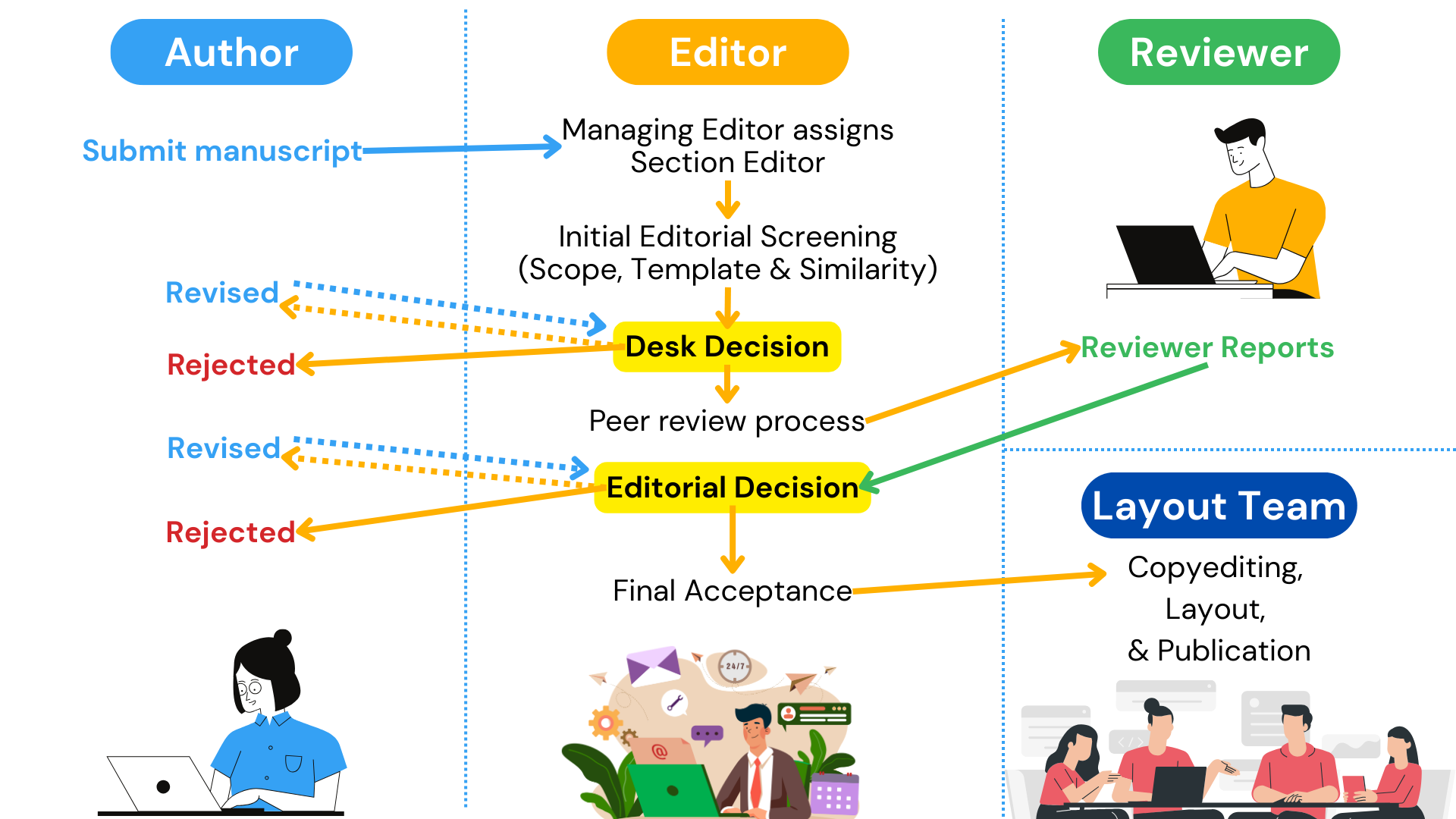
Figure 1. Editorial and peer review workflow of Jurnal FisTa: Fisika dan Terapannya.
Initial Editorial Screening
Upon submission, the Managing Editor assigns the manuscript to a Section Editor for initial editorial evaluation. This stage assesses the relevance of the manuscript to the journal's focus and scope, compliance with the article template and author guidelines, originality, scientific quality, and completeness of submission requirements.
Submitted manuscripts are also screened using similarity detection software in accordance with the journal's Plagiarism Policy. The editorial team evaluates the similarity report to identify potential plagiarism or inappropriate citation practices.
Following the initial screening, manuscripts may be returned to the authors for revision, rejected through a desk decision, or forwarded for external peer review.
Reviewer Selection and Assignment
Manuscripts that pass the initial screening are evaluated by at least two independent reviewers with expertise relevant to the research topic and methodology.
Reviewers are selected based on their academic competence, research expertise, independence, and ability to provide objective scientific assessments. Potential conflicts of interest are considered during the reviewer selection process.
When necessary, additional reviewers may be invited to provide further evaluation, particularly when the initial review recommendations differ substantially or additional expertise is required.
Peer Review Evaluation Criteria
Reviewers evaluate manuscripts based on scientific merit, originality, methodological quality, reliability of findings, and contribution to the development of physics and its applications.
The evaluation includes the following aspects:
- Relevance of the research topic to the journal's focus and scope.
- Originality, novelty, and scientific contribution of the research.
- Clarity of the research background, problem formulation, and objectives.
- Appropriateness and completeness of the research methodology.
- Validity and reliability of experimental data, measurements, simulations, or theoretical analyses.
- Clarity and accuracy of tables, graphs, figures, and scientific measurements.
- Depth of analysis and interpretation of the research findings.
- Relevance of references and comparison with previous scientific studies.
- Consistency between research objectives, results, discussion, and conclusions.
- Compliance with academic integrity and publication ethics.
Reviewers are expected to provide constructive comments, scientific arguments, and recommendations that assist authors in improving their manuscripts and support editorial decision-making.
Editorial Decisions
After receiving the reviewers' reports, the editor evaluates the manuscript and determines the appropriate editorial decision. The decision considers the reviewers' assessments, the scientific quality of the research, and compliance with the journal's editorial standards.
Possible editorial decisions include:
- Accept Submission: The manuscript meets the scientific and editorial requirements for publication.
- Revisions Required: The manuscript requires revisions based on reviewer comments or editorial recommendations.
- Resubmit for Review: The manuscript requires substantial revisions and further scientific evaluation.
- Decline Submission: The manuscript does not meet the scientific, methodological, ethical, or editorial requirements of the journal.
The final editorial decision remains the responsibility of the authorized editor. Reviewers provide scientific recommendations but do not independently determine whether a manuscript is accepted or rejected.
Manuscript Revision and Reassessment
Authors receiving revision requests are expected to address the comments and recommendations provided by reviewers and editors.
Revised manuscripts should be accompanied by a clear response explaining how the comments have been addressed. When authors disagree with particular recommendations, they should provide appropriate scientific justification.
The editor assesses the revised manuscript and determines whether further revisions or additional peer review are necessary. Manuscripts may be returned to the original reviewers for reassessment when substantial scientific issues require further evaluation.
Confidentiality and Review Integrity
All manuscripts, reviewer reports, and editorial correspondence are treated as confidential throughout the editorial and peer review process.
Editors and reviewers must not disclose unpublished manuscript content or use confidential research information for personal benefit. Reviewers are expected to disclose potential conflicts of interest and withdraw from the review process when their impartiality may be compromised.
The use of Artificial Intelligence (AI) during manuscript evaluation must comply with the journal's AI Policy, particularly regarding confidentiality, data protection, and independent human judgment.
Documentation of the Peer Review Process
Jurnal FisTa: Fisika dan Terapannya maintains appropriate documentation of its editorial and peer review activities through Open Journal Systems (OJS) and official editorial correspondence.
Relevant records include manuscript submissions, reviewer assignments, peer review reports, editorial recommendations, author responses, manuscript revisions, and final editorial decisions.
These records support the transparency, traceability, and accountability of the publication process while maintaining the confidentiality of reviewer identities and unpublished manuscripts.
Copyediting, Layout, and Publication
Manuscripts that receive final acceptance proceed to the production stage, which includes copyediting, layout preparation, proofreading, and publication.
Authors may be requested to review the final proof to ensure that the published article accurately represents the accepted manuscript.
Articles are published after completing the required editorial and production procedures in accordance with the journal's publication schedule.
Publication Ethics and Peer Review Standards
Jurnal FisTa: Fisika dan Terapannya is committed to conducting a fair, independent, confidential, and transparent peer review process in accordance with its publication ethics policies and relevant recommendations of the Committee on Publication Ethics (COPE).
For further information, please refer to the journal's Publication Ethics, Plagiarism Policy, and the Committee on Publication Ethics (COPE).