
Klasifikasi dan Estimasi Ketinggian Planetary Boundary Layer (PBL) Menggunakan Data Radiosonde
Article Sidebar
Main Article Content
Abstract
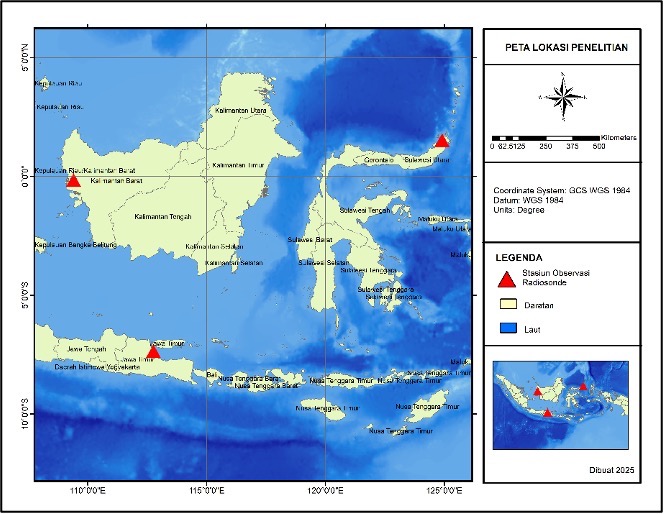
The Planetary Boundary Layer (PBL) is the atmospheric layer closest to the Earth’s surface that plays a crucial role in weather dynamics. This study aims to classify the types and estimate the heights of the PBL in three regions of Indonesia representing different latitudes using radiosonde data during the period of January–December 2024. Classification was performed using the Potential Temperature Difference (PTD) method, while PBL height estimation utilized the potential temperature gradient, relative humidity, and parcel methods. The results show that at 00:00 UTC, the PBL is dominated by a stable boundary layer (SBL), whereas at 12:00 UTC, there is an increase in variability with the emergence of a neutral boundary layer (NBL) and a convective boundary layer (CBL). Estimates of PBL height ranged from <500 m to >2000 m, with the lowest values generally occurring in the morning and the highest during the JJA period. This study demonstrates that PBL variability in Indonesia is controlled by diurnal cycles, latitudinal differences, and atmospheric thermodynamic conditions, and contributes to the understanding of PBL characteristics in tropical maritime regions.
Article Details

This work is licensed under a Creative Commons Attribution-NonCommercial-ShareAlike 4.0 International License.
References
Apriadi, A. (2023). Analisa Data Radiosonde Untuk Menentukan Ketinggian Planetary Boundary Layer (Pbl) Dengan Menggunakan Gradien Suhu Potensial (Doctoral Dissertation, Universitas Bina Darma).
Aryee, J. N. A., Amekudzi, L. K., Preko, K., Atiah, W. A., & Danuor, S. K. (2020). Estimation of planetary boundary layer height from radiosonde profiles over West Africa during the AMMA field campaign: Intercomparison of different methods. Scientific African, 7, e00228. https://doi.org/10.1016/j.sciaf.2019.e00228.
Chan, K. M., & Wood, R. (2013). The seasonal cycle of planetary boundary layer depth determined using COSMIC radio occultation data. Journal of Geophysical Research: Atmospheres, 118(22). https://doi.org/10.1002/2013JD020147
Garratt, J. R. (1994). Review: the atmospheric boundary layer. Earth-Science Reviews, 37(1), 89–134. https://doi.org/https://doi.org/10.1016/0012-8252(94)90026-4
Garratt, J. R., Wyngaard, J. C., & Francey, R. J. (1982). Winds in the atmospheric boundary layer-prediction and observation. Journal of Atmospheric Sciences, 39(6), 1307-1316.
Guo, J., Liu, B., Gong, W., Shi, L., Zhang, Y., Ma, Y., ... & Xu, X. (2021). First comparison of wind observations from ESA's satellite mission Aeolus and ground-based radar wind profiler network of China. Atmospheric Chemistry and Physics, 21(4), 2945-2958. https://doi.org/10.5194/acp-21-2945-2021
Gu, J., Zhang, Y., Yang, N., & Wang, R. (2020). Diurnal variability of the planetary boundary layer height estimated from radiosonde data. Earth and Planetary Physics, 4(5), 1–14. https://doi.org/10.26464/epp2020042.
Hamdi, S., Radiana, A., Tanti, D. A., Adetya, E., Sumaryati, Setyawati, W., ... & Noviastuti, N. (2023, November). The Estimation of Planetary Boundary Layer Height Over Land and Peat Fire-Prone Area in Kabupaten OKI of South Sumatra Indonesia Using Radiosonde Data. International Conference on Radioscience, Equatorial Atmospheric Science and Environment (pp. 65-74). Singapore: Springer Nature Singapore. https://doi.org/10.1007/978-981-97-0740-9_7.
Hashiguchi, H., Fukao, S., Tsuda, T., Yamanaka, M. D., Tobing, D. L., Sribimawati, T., Harijono, S. W. B., & Wiryosumarto, H. (1995). Observations of the planetary boundary layer over equatorial Indonesia with an L band clear‐air Doppler radar: Initial results. Radio Science, 30(4), 1043–1054. https://doi.org/10.1029/95RS00653.
Kurzeja, R. J., Berman, S., & Weber, A. H. (1991). A climatological study of the nocturnal planetary boundary layer. Boundary-layer meteorology, 54(1), 105-128. https://doi.org/10.1007/BF00119415.
Li, H., Liu, B., Ma, X., Jin, S., Ma, Y., Zhao, Y., & Gong, W. (2021). Evaluation of retrieval methods for planetary boundary layer height based on radiosonde data. Atmospheric Measurement Techniques, 14(9), 5977–5986. https://doi.org/10.5194/amt-14-5977-2021.
Li, H., Liu, B., Ma, X., Jin, S., Wang, W., Fan, R., ... & Gong, W. (2023). Estimation of planetary boundary layer height from lidar by combining gradient method and machine learning algorithms. IEEE Transactions on Geoscience and Remote Sensing, 61, 1-11. https://doi.org/10.1109/TGRS.2023.3329122.
Liu, S., & Liang, X.-Z. (2010). Observed Diurnal Cycle Climatology of Planetary Boundary Layer Height. Journal of Climate, 23(21), 5790–5809. https://doi.org/10.1175/2010JCLI3552.1
Mehta, S. K., Ratnam, M. V., Sunilkumar, S. V., Rao, D. N., & Krishna Murthy, B. V. (2016). Diurnal variability of the atmospheric boundary layer height over a tropical station in the Indian monsoon region. Atmospheric Chemistry and Physics Discussions. https://doi.org/10.5194/acp-2016-542
Seidel, D. J., Ao, C. O., & Li, K. (2010). Estimating climatological planetary boundary layer heights from radiosonde observations: Comparison of methods and uncertainty analysis. Journal of Geophysical Research: Atmospheres, 115(D16). https://doi.org/10.1029/2009JD013680
Stull, R. B. (2012). An introduction to boundary layer meteorology (Vol. 13). Springer Science & Business Media.
Stull, R. B. (1988). An Introduction to Boundary Layer Meteorology (R. B. Stull, Ed.). Springer Netherlands. https://doi.org/10.1007/978-94-009-3027-8.
Su, T., Li, Z., & Kahn, R. (2020). A new method to retrieve the diurnal variability of planetary boundary layer height from lidar under different thermodynamic stability conditions. Remote Sensing of Environment, 237, 111519. https://doi.org/10.1016/j.rse.2019.111519.
Vogelezang, D. H. P., & Holtslag, A. A. M. (1996). Evaluation and model impacts of alternative boundary-layer height formulations. Boundary-Layer Meteorology, 81(3), 245-269. https://doi.org/10.1007/bf02430331.
Wang, Z., Xue, L., Shin, H. H., Chu, Y., & Li, W. (2024). Understanding Processes Controlling the Temporal and Spatial Variations of PBL Structures Over the ARM SGP Site (No. DOE-CUB-SC0020171). Univ. of Colorado, Boulder, CO (United States). https://doi.org/10.2172/2480894.
Xi, X., Zhang, Y., Gao, Z., Yang, Y., Zhou, S., Duan, Z., & Yin, J. (2022). Diurnal climatology of correlations between the planetary boundary layer height and surface meteorological factors over the contiguous United States. International Journal of Climatology, 42(10), https://doi.org/5092-5110. 10.1002/joc.7521.
Zhang, D., Comstock, J., Sivaraman, C., Mo, K., Krishnamurthy, R., Tian, J., ... & Roldán-Henao, N. (2025). Best estimate of the planetary boundary layer height from multiple remote sensing measurements. Atmospheric Measurement Techniques, 18(14), 3453-3475. https://doi.org/10.5194/amt-18-3453-2025.