
Karakterisasi Gugus Fungsi Arang Aktif Sabut Kelapa dengan Metode Pirolisis
Article Sidebar
Main Article Content
Abstract
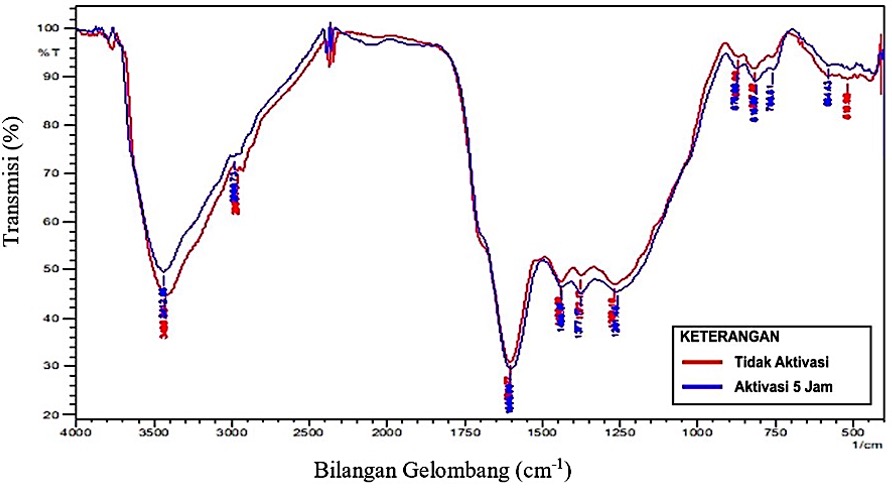
Activated charcoal can be produced from carbon-containing materials or from activated charcoal to get a wider surface area. Coconut coir is a part of coconut waste that is rarely forgiven. The researcher discussed the functional groups of activated charcoal from coconut coir with 10 ml of KOH activator. The purpose of this study was to determine the active charcoal content contained in coconut coir. The method used is the pyrolysis method in which combustion occurs in a furnace without oxygen at a temperature of 4000C. The analysis carried out by the researchers included a wave number spectrum analysis using the FTIR tool for coconut coir activated carbon. The identification results using the FTIR spectrophotometer showed that the activated charcoal in this study contained functional groups O-H, -O-, C-O, C=C, C-H
Article Details

This work is licensed under a Creative Commons Attribution-NonCommercial-ShareAlike 4.0 International License.
References
Hartanto, D. A., Yuwita, E., & Faila, R. N. (2023). Karakterisasi Gugus Fungsi Pada Karbon Aktif Kulit Jagung Menggunakan Uji Fourier Transform Infrared S ebagai Bahan Pembuatan Adsorben (Vol. 4, Number 1).
Immaduddin, H. F., Amrullah, S., Nurkholis, & Rahayu, T. E. P. S. (2021). Pengolahan Limbah Tempurung Kemiri Sebagai Adsorben Senyawa Etilen Dengan Penambahan Kalium Permanganat (KMnO4). Jurnal Pengendalian Pencemaran Lingkungan, 3(1), 13–19.
Jefriadi, J., Jelita, R., Nurhaliza, & Nailisa, N. (2025). Karbon Aktif dari Limbah Sawi Putih untuk Adsorpsi Ion Mangan (Mn). Jurnal Teknologi Agro-Industri, 12(1), 70–80. https://doi.org/10.34128/jtai.v12i1.236
Kawulur, K., Taunaumang, H., Iwan Umboh, S., & Adfie Netty Bujung, C. (2025). Pemanfaatan Karbon Aktif dari Cangkang Kemiri sebagai Elektroda Superkapasitor. In Oktober (Vol. 6, Number 2).
Kimbal, A. J., Taunaumang, H., Tumimomor, F. R., Rampengan, A. M., & Pawarangan, I. (2025). Karakteristik Karbon Aktif Berbasis Limbah Pelepah Kelapa dengan Variasi Konsentrasi KOH Sebagai Material Elektroda Superkapasitor. 8(1).
Kondo, Y., & Arsyad, M. (2018). Analisis Kandungan Lignin, Sellulosa, dan Hemisellulosa Serat Sabut Kelapa Akibat Perlakuan Alkali. INTEK: Jurnal Penelitian, 5(2), 94–97. https://doi.org/10.31963/intek.v5i2.578
Lb, F., Yusuf Lubis, R., & Sirait, R. (2023). PEMBUATAN KARBON AKTIF DARI SABUT KELAPA DENGAN AKTIVASI MENGGUNAKAN H3PO4 UNTUK ADSORPSI AIR GAMBUT. JOURNAL ONLINE OF PHYSICS, 8(2), 23–28. https://doi.org/10.22437/jop.v8i2.20677
Pongajow, M. S., Taunaumang, H., Tumimomor, F. R., & Rampengan, A. M. (2023). Pengaruh Suhu Proses Karbonasi Terhadap Konduktivitas Listrik Arang Bambu Sebagai Elektroda Superkapasitor. Konstanta : Jurnal Matematika Dan Ilmu Pengetahuan Alam, 2(1), 22–31. https://doi.org/10.59581/konstanta.v2i1.1880
Montfort, G. R. C., Azamar-Barrios, J. A., Quintana-Owen, P., Rejón-Moo, V., González-Gómez, W. S., & Madera-Santana, T. J. (2025). Production and Physicochemical Characterization of Activated Carbon from the Mesocarp of the Coconut (Cocos nucifera L.) Variety Alto del Pacifico. Chemistry, 7(3), 88. https://doi.org/10.3390/chemistry7030088
Mudaim, S., & Hidayat, S. (2021). Analisis Proksimat Karbon Kulit Kemiri (Aleurites Moluccana) Dengan Variasi Suhu Karbonisasi. Jurnal Ilmu Dan Inovasi Fisika), 05(02), 157–163.
Muhsinun, M., & Hidayat, S. (2025). Potensi Karbon Aktif dari Kulit Durian dengan Aktivator HCl untuk Immobilisasi Asam Lemak Hidroksamat. Varied Knowledge Journal, 3(1), 40–47. https://doi.org/10.71094/vkj.v3i1.128
Muliani, S. (2022). Modifikasi Permukaan Karbon Aktif dari Tempurung Kemiri (Aleurites moluccana) dengan HNO3 dan Aplikasinya sebagai Adsorben Zat Warna Metil Jingga [Universitas Hasanuddin]. https://repository.unhas.ac.id/id/eprint/19775/
Ni`mah, L., Mahfud, M., & Juliastuti, S. R. (2022). Study of Activated Carbon from Coconut Shell Waste to Adsorb Cu and Mn Metals in Acid Mine Drainage. Journal of Fibers and Polymer Composites, 1(1), 34–42. https://doi.org/10.55043/jfpc.v1i1.35
Nurhafika Ayu Saputri, Jasruddin, & Vicran Zharvan. (2025). SINTESIS MEMBRAN BERBASIS KARBON AKTIF MENGGUNAKAN AKTIVATOR H3PO4 BERBAHAN DASAR TEMPURUNG KELAPA. Jurnal Sains Dan Pendidikan Fisika, 21(1), 98–106. https://doi.org/10.35580/jspf.v21i1.6189
Pavia, D. L., Lampman, G. M., Kriz, G. S., & Vyvyan, J. R. (2013). Introduction to Spectroscopy (Fifth). CENGAGE Learning.
Rahma, A. N., Oktavianti, E. D., Meidinariasty, A., Kimia, J. T., D4, P., Kimia Industri, T., Negeri, P., Politeknik, S., Sriwijaya, N., Negara, J. S., Besar, B., Ilir Barat, K., Palembang, I. K., & Selatan -30139, S. (2025). Aktivasi Karbon Aktif dari Sekam Padi dan Cangkang Kelapa Sawit dengan H2SO4 Sebagai Media Adsorpsi Amonia (NH3). Chemical Engineering Journal Storage, 5(6), 1167–1176. https://doi.org/10.29103/cejs.v5i6.24200
Ramadhani, L. F., Imaya M. Nurjannah, Ratna Yulistiani, & Erwan A. Saputro. (2020). Review: teknologi aktivasi fisika pada pembuatan karbon aktif dari limbah tempurung kelapa. Jurnal Teknik Kimia, 26(2), 42–53. https://doi.org/10.36706/jtk.v26i2.518
Reza, M. S., Yun, C. S., Afroze, S., Radenahmad, N., Bakar, M. S. A., Saidur, R., Taweekun, J., & Azad, A. K. (2020). Preparation of activated carbon from biomass and its’ applications in water and gas purification, a review. Arab Journal of Basic and Applied Sciences, 27(1), 208–238. https://doi.org/10.1080/25765299.2020.1766799
Shahcheragh, S. K., Bagheri Mohagheghi, M. M., & Shirpay, A. (2023). Effect of physical and chemical activation methods on the structure, optical absorbance, band gap and urbach energy of porous activated carbon. SN Applied Sciences, 5(12), 313. https://doi.org/10.1007/s42452-023-05559-6
Stefan, M., Stefan, I., Negoita, I.-A., Ordeanu, V., & Stefan, D. S. (2021). Influence of Internal Structure of the Sorbents on Diazepam Sorption from Simulated Intestinal Fluid. Applied Sciences, 11(3), 1158. https://doi.org/10.3390/app11031158
Sudibandriyo, M., & Rizki, A. (2024). The Influence of Activated Carbon as Adsorbent in Adsorptive – Distillation of Ethanol–Water Mixture. International Journal of Technology, 15(2), 425. https://doi.org/10.14716/ijtech.v15i2.6659
Vârban, R., Crișan, I., Vârban, D., Ona, A., Olar, L., Stoie, A., & Ștefan, R. (2021). Comparative FT-IR Prospecting for Cellulose in Stems of Some Fiber Plants: Flax, Velvet Leaf, Hemp and Jute. Applied Sciences, 11(18), 8570. https://doi.org/10.3390/app11188570
Wang, B., Lan, J., Bo, C., Gong, B., & Ou, J. (2023). Adsorption of heavy metal onto biomass-derived activated carbon: review. RSC Advances, 13(7), 4275–4302. https://doi.org/10.1039/D2RA07911A
Watulingas, A. N., Rampengan, A. M., Tumimomor, F. R., Wenas, D. R., & Nusa, J. G. N. (2024). Pemanfaatan Karbon Aktif Eceng Gondok (Eichhornia Crassipes) Sebagai Material Elektroda Superkapasitor dengan Variasi Kosentrasi Elektrolit. Jurnal SOSCIED, 7(2).
Yuliasari, N., Hidayati, N., & Anandika, A. (2025). Sonikasi adsorpsi congo red oleh hidrochar ampas tebu termodifikasi Co(OH)2. Jurnal Penelitian Sains, 27(1), 1. https://doi.org/10.56064/jps.v27i1.1178