
Karakterisasi Struktur Karbon Aktif Sabut Kelapa Sebagai Material Elektroda Superkapasitor
Article Sidebar
Main Article Content
Abstract
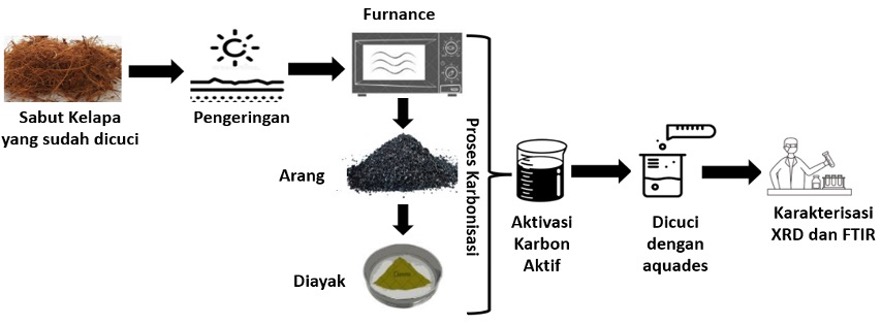
In today's modern life, electrical energy has become a primary need that cannot be avoided. Supercapacitors are a new breakthrough in the field of energy storage, where supercapacitors have a higher power density than batteries and have a higher energy density compared to conventional capacitors. This study characterized the structure of coconut fiber activated carbon activated with NaOH with varying concentrations of 3 M and 5 M. Testing on X-ray Diffraction (XRD) showed the absence of sharp peaks which confirms that this activated carbon is amorphous, meaning carbon that is not arranged in a perfect crystal. Meanwhile, the FTIR test of 3M Coconut Fiber Activated Carbon confirmed many oxygen groups (C-O 1044 cm-1 1044 cm-1, strong aromatic peak (1567 cm⁻¹), more polar surface, and higher concentration of 5M deoxygenation (C–O weakens/disappears), more graphitized aromatic structure, higher porosity (CO₂ adsorbed ↑), more nonpolar surface. Meanwhile, coconut fiber charcoal (without activation) confirmed the main chemical components of coconut fiber, especially dominant cellulose, lignin and hemicellulose.
Article Details

This work is licensed under a Creative Commons Attribution-NonCommercial-ShareAlike 4.0 International License.
References
Budianto, A., Romiarto, & Fitrianingtyas. (2018). Pemanfaatan Limbah Kakao ( Theobroma cacao L ) sebagai Karbon Aktif dengan Aktivator Termal dan Kimia. Jurnal Teknik Kimia, (August), 207–212.
Chang, L.-L., Hu, C., Huang, C.-C., Lin, C.-Y., Chung, P.-W., & Tung, K.-L. (2023). Potassium Citrate-Activated Porous Carbon Nanostructures for CO 2 Adsorption and Electroreduction. ACS Applied Nano Materials, 6(10), 8839–8848. https://doi.org/10.1021/acsanm.3c01231
Elina, R., Rori, D. C., & Khair, M. (2023). Karakterisasi FTIR pada Karbon Aktif Terimpregnasi ZnO Program Studi Kimia , Universitas Negeri Padang. 7, 23827–23831.
Erawati, E., Firdausi, E., & Afifah, N. (2018). The 8 th University Research Colloquium 2018 Universitas Muhammadiyah Purwokerto PEMBUATAN KARBON AKTIF DARI GERGAJI KAYU JATI ( Tectona grandis L , f ) ( UKURAN PARTIKEL DAN JENIS AKTIVATOR ) MAKING ACTIVED CARBON FROM TEAK WOOD SAWS ( Tectona grandis L , f ) ( PARTICLE SIZE AND ACTIVATOR TYPE ) The 8 th University Research Colloquium 2018 Universitas Muhammadiyah Purwokerto. 97–104.
Ester Kapantow, K., Musa Rampengan, A., Reynol Tumimomor, F., Taunaumang, H., & Iwan Umboh, S. (n.d.). Pemanfaatan Karbon Aktif Dari Limbah Kulit Pisang Kepok (Musa Paradisiaca L) Sebagai Elektroda Superkapasitor. In Oktober (Vol. 6, Number 2).
Hartanto, D. A., Yuwita, P. E., Faila, R. N., Studi, P., Mesin, T., Nahdlatul, U., & Sunan, U. (2023). MENGGUNAKAN UJI FOURIER TRANSFORM INFRARED SEBAGAI BAHAN. 4(1).
Latupeirissa, J., Tanasale, M. F. J. D. P., Dade, K., & Kemiri, G. T. (2016). Jolantje Latupeirissa*, Matheis F.J.D.P. Tanasale, Kalam Dade. 3(2), 324–328.
Maulida, H., Elwina, E., & Fachraniah, F. (2024). Pembuatan Karbon Aktif Dari Limbah Kulit Jeruk Manis (Citrus sinensis L) Sebagai Adsorben Ion Besi (Fe2+) Dalam Air Sumur. Jurnal Riset, Inovasi, Teknologi & Terapan, 2(1), 23. https://doi.org/10.30811/ristera.v2i1.4970
Muflihatun. (2025). Pemanfaatan Karbon Aktif Berbasis Biomassa Lokal sebagai Material Elektroda Superkapasitor : Review. 6(1), 22–29.
Ningtyas, K. R., Sarono, Analianasari, Nugraha Agassi, T. N., Gina Putri, P., & Perdiansyah H, M. M. (2022). Pemanfaatan Limbah Sabut Kelapa Sebagai Produk Unggulan Lokal. Jurnal Pengabdian Nasional, 3(1), 1–6.
Nurul Huda, A. (2022a). Pemanfaatan Karbon Aktif dari Sekam Padi Sebagai Elektroda Superkapasitor. Jurnal Ilmu Dan Inovasi Fisika, 6(2), 102–113. https://doi.org/10.24198/jiif.v6i2.39639
Peday, H. T. N., & Sialana, J. (2025). FT-UMSU FT-UMSU. 8(1), 146–154.
Pongajow, M. S., Taunaumang, H., Tumimomor, F. R., & Rampengan, A. M. (2023). Pengaruh Suhu Proses Karbonasi Terhadap Konduktivitas Listrik Arang Bambu Sebagai Elektroda Superkapasitor. Konstanta : Jurnal Matematika Dan Ilmu Pengetahuan Alam, 2(1), 22–31. https://doi.org/10.59581/konstanta.v2i1.1880
Priambudi, A., & Susanti, A. (2024). PROSES PEMBUATAN KARBON AKTIF DARI SERBUK GERGAJI KAYU DARI DAERAH MALANG, MENGGUNAKAN AKTIVATOR NaOH. DISTILAT: Jurnal Teknologi Separasi, 10(1), 256–265. https://doi.org/10.33795/distilat.v10i1.4885
Silaban, D. P. (2018). SINTESIS KARBON AKTIF DARI ARANG TEMPURUNG KELAPA LIMBAH MESIN BOILER SEBAGAI BAHAN PENYERAP LOGAM Cd , Cu dan Pb ACTIVATED CARBON MADE OF COCONUT SHELL CHARCOAL FROM BOILER.
Suastika, R., & Sirait, R. (2023). Pengaruh Suhu Aktivasi Fisika Terhadap Uji Mikrostruktur Karbon Aktif Mangrove. 6, 262–271.
Subamia, I. D. P., Widiasih, N. N., Sri Wahyuni, I. G. A. N., & Pratami Kristiyanti, P. L. (2023). Optimasi Kinerja Alat Fourier Transform Infrared (FTIR) Melaui Studi Perbandingan Komposisi dan Ketebalan Sampel-KBr. Jurnal Pengelolaan Laboratorium Pendidikan, 5(2), 58–69. https://doi.org/10.14710/jplp.5.2.58-69
Taslim, R., Sari, M. N., & Taer, E. (2017). Studi Awal Pembuatan Karakteristik Elektroda Superkapsitor Dari Limbah Pelepah Kelapa Sawit. Prosiding SNFUR, 180–184.
Taunaumang, H., Pawarangan, I., & Tumimomor, F. (n.d.). Efek Suhu Aktivasi Terhadap Struktur Mikro Material Karbon Aktif Pelepah Enceng Gondok Untuk Aplikasi Elektroda Superkapasitor. X.
Tumimomor, F. R., & Palilingan, S. C. (2018). Pemanfaatan karbon aktif dari sabut kelapa sebagai elektroda superkapasitor. Fullerene Journal of Chemistry, 3(1), 13. https://doi.org/10.37033/fjc.v3i1.29