
Evaluasi Akurasi Metode Arus Cabang Melalui Pendekatan Teoritis, Simulasi EWB, dan Pengukuran Eksperimental
Article Sidebar
Main Article Content
Abstract
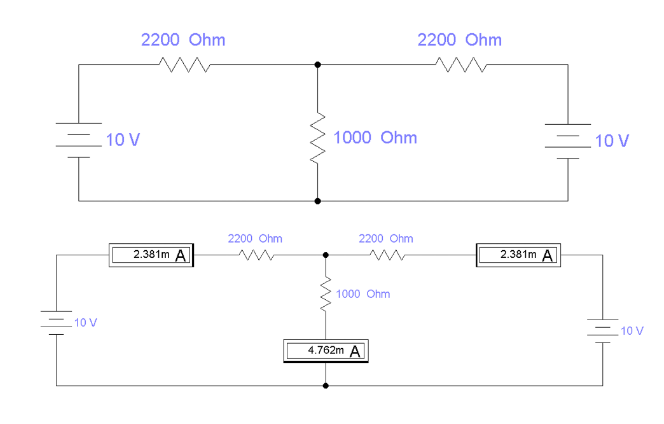
This study aims to evaluate the accuracy of the branch current analysis method through three approaches: theoretical calculation, simulation using Electronics Workbench (EWB), and experimental measurement using a digital multimeter. The test circuit consists of two 10 V DC voltage sources and three resistors (R1 = 2200 Ω, R2 = 2200 Ω, R3 = 1000 Ω) forming two loops with three branch currents (I1, I2, I3). The theoretical analysis was performed by applying Kirchhoff’s Current Law (KCL) and Kirchhoff’s Voltage Law (KVL), while the simulation was conducted in EWB software with the same configuration. Direct measurements were obtained by connecting the multimeter in series with each branch. The results show that the simulated current values closely match the theoretical calculations, with a maximum relative error of 0.0084% and an accuracy of 99%. Meanwhile, the experimental measurements exhibit larger deviations compared to the simulation, ranging from 1% to 2 %, with accuracies between 97% and 98%. Overall, the study demonstrates that the branch current method produces consistent results between theoretical calculations and simulations, while the experimental measurements show deviations that remain within acceptable limits due to component tolerances, connection resistance, and instrument accuracy.
Article Details

This work is licensed under a Creative Commons Attribution-NonCommercial-ShareAlike 4.0 International License.
References
Dermawanda Lase, J. S. M. (2025). Analisis literatur tentang hukum kirchoff dalam desain rangkaian listrik modern. IDENTIK: Jurnal Ilmu Ekonomi, Pendidikan Dan Teknik, 02(02), 15–21.
Duri, A. (2023). Penerapan Hybrid Artificial Bee Colony and Differential Evolution pada Optimasi Ekonomis Pembangkit Listrik = The Application of Hybrid Artificial Bee Colony and Differential Evolution in the Economic Dispatch of Power Plants [Universitas Hasanuddin]. https://repository.unhas.ac.id/id/eprint/32355/2/D032202002_tesis_27-09-2023 bab 1-2.pdf
Fuada, S., Jannah, N. F., Zarkasyi, E. N., Hady, M. F., Cantika, R. I. N. A., & Nurizky, T. G. (2024). Analisis Rangkaian Mesh dengan Aplikasi Android Proto Circuit dan Pembuktiannya dengan Eksperimen Real. Journal Of Electrical Engineering And Technology, 5(1), 1–13.
Handayani, S., & Huda, D. N. (2024). Analisis Rangkaian Listrik Hukum Kirchhoff Menggunakan Solusi Simbolis di Matlab. Remik: Riset Dan E-Jurnal Manajemen Informatika Komputer, 8(2), 705–711.
Hutagalung, S. N., & Panjaitan, M. (2024). Pelatihan Rangkaian Listrik Dengan Menggunakan Software Electronic Workbench di SMA Negeri 14 Medan. Jumas : Jurnal Masyarakat, 03(1), 1–6.
Jannah, N. F., Fuada, S., Hasugian, L. P., & Heong, Y. M. (2024). Pemanfaatan Simulator TINA-TI Untuk Analisis Rangkaian Mesh dan Perbandingannya dengan Eksperimen Aktual. Junal Kajian Teknik Elektro, 9(1), 8–16.
Jaya, G. W., & Aponno, S. V. (2023). Kajian Teori Arus Listrik dan Daya Listrik pada Rangkaian Resistor Seri dan Paralel Berdasarkan Jumlah Resistor yang Digunakan. ORBITA. Jurnal Hasil Kajian, Inovasi, Dan Aplikasi Pendidikan Fisika, 9(1), 87–93.
Kuron, M., & Umboh, A. (2021). Pengaruh Virtualisasi Laboratorium Berbasis Electronics Workbench ( EWB ) pada Mata Kuliah Elektronika Dasar UNSRIT. ORBITA. Jurnal Hasil Kajian, Inovasi, Dan Aplikasi Pendidikan Fisika, 7(1), 1–7.
Mustika, R., Anam, M. K., & Abiyaksa, M. (2022). Analysis of Resistor Color Differences Against Resistance Values. JEEE: Journal OfEducational Engineering and Environment, 1(1), 31–33.
Noga, K. M. (2018). The Simulation Laboratory Platform Based on Multisim for Electronic Engineering Education. INTERNATIONAL CONFERENCE ON SIGNALS AND ELECTRONIC SYSTEMS (ICSES), 269–274. https://doi.org/10.1109/ICSES.2018.8507313
Siti Nurhidayah, Didik Aribowo, D. (2020). Penerapan Aplikasi Simulasi Electronic Workbench dan Proteus pada Materi Penerapan Rangkaian Elektronika bagi Siswa Kelas XI Teknik Elektronika Industri. Jurnal Edukasi Elektro, 4(2), 120–128.
Vrbik, J. (2022). Solving Electrical Circuits via Graph Theory. Applied Mathematics, 13(1), 77–86. https://doi.org/10.4236/am.2022.131007