
Verifikasi Hukum Boyle dan Tekanan Hidrostatik Dengan Barometer Digital PS-3203
Article Sidebar
Main Article Content
Abstract
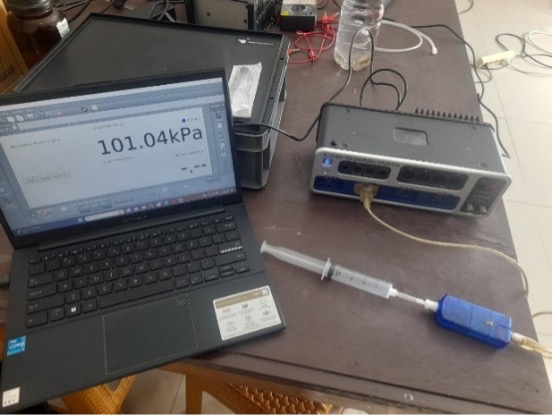
This study investigates the relationship between gas pressure–volume behavior and liquid pressure–depth characteristics through experiments utilizing a PS-3203 pressure sensor. The objective is to quantitatively verify Boyle’s Law for gases and the hydrostatic pressure principle for liquids using digital pressure measurements. In the gas experiment, the air volume was adjusted using a syringe, and the pressure was recorded automatically. The results demonstrate an inverse proportionality between pressure and volume, confirming the equation . In the liquid experiment, pressure was observed to increase linearly with depth, with a gradient of 0,096 kPa/cm, corresponding to a water density of 979,6 kg/m³, indicating an approximate 2% deviation from the theoretical value. These findings validate both physical laws and demonstrate that the PS-3203 digital sensor can accurately verify Boyle’s Law and hydrostatic pressure while improving measurement precision and experimental efficiency.
Article Details

This work is licensed under a Creative Commons Attribution-NonCommercial-ShareAlike 4.0 International License.
References
Hernández-Vásquez, J. D., Jutínico-Alarcon, A. L., Simanca-Celedon, E. A., Romero-Acuña, A., Orozco-Lozano, W., Villate-Fonseca, M., & Campuzano, M. J. (2023). Comparison of Different Methods to Evaluate Measurement Uncertainty in Bimetallic Thermometers Used in Industrial Equipment. International Journal of Technology, 14(2), 374–386. https://doi.org/10.14716/ijtech.v14i2.5549
Holmes, N. G., Olsen, J., Thomas, J. L., & Wieman, C. E. (2017). Value added or misattributed? A multi-institution study on the educational benefit of labs for reinforcing physics content. Physical Review Physics Education Research, 13(1). https://doi.org/10.1103/PhysRevPhysEducRes.13.010129
Kerr, J. R., White, P. R., Leighton, T. G., Silva, L. G. M., & Kemp, P. S. (2023). Boyle’s Law ignores dynamic processes in governing barotrauma in fish. Scientific Reports, 13(1). https://doi.org/10.1038/s41598-023-46125-9
Kurniawan, A., & Nugroho, R. (2021). Analisis hubungan tekanan–volume gas menggunakan sensor PASCO berbasis data real-time. Jurnal Fisika Dan Aplikasinya, 17(2), 45–52.
Madani, N. A., Purnamaningsih, R. W., Poespawati, N. R., Hamidah, M., Rahardjo, S., & Wibowo, D. K. (2023). Detection of Low Hydrostatic Pressure Using Fiber Bragg Grating Sensor. International Journal of Technology, 14(7), 1527–1536. https://doi.org/10.14716/ijtech.v14i7.6714
Meyrida Riana, & Anggini. (2024). Hukum-Hukum Gas Ideal. Pentagon : Jurnal Matematika Dan Ilmu Pengetahuan Alam, 2(3), 01–07. https://doi.org/10.62383/pentagon.v2i3.188
PASCO Scientific. (2019). Wireless Pressure Sensor (PS-3203) Technical Data Sheet.
PASCO Scientific. (2020). PASCO Capstone User’s Guide.
Pollard, B., Hobbs, R., Henderson, R., Caballero, M. D., & Lewandowski, H. J. (2021). Introductory physics lab instructors’ perspectives on measurement uncertainty. Physical Review Physics Education Research, 17(1). https://doi.org/10.1103/PhysRevPhysEducRes.17.010133
Porter, C. D., & Heckler, A. F. (2020). Effectiveness of guided group work in graduate level quantum mechanics. Physical Review Physics Education Research, 16(2). https://doi.org/10.1103/PhysRevPhysEducRes.16.020127
Sharma, P., & Sinha, A. (2020). Experimental study of hydrostatic pressure using modern digital sensors. International Journal of Applied Physics Education, 8(1), 22–28.
Sujito, S., Sulur, S., Hudha, M. N., Winarno, N., & Sunardi, S. (2024). Enhanced learning: Designing bifocal modeling practicum tools with ESP32 for exploring kinetic theory of gases. Momentum: Physics Education Journal, 8(2). https://doi.org/10.21067/mpej.v8i2.10046
Weenink, R. P., & Wingelaar, T. T. (2021). The Circulatory Effects of Increased Hydrostatic Pressure Due to Immersion and Submersion. Frontiers in Physiology, 12. https://doi.org/10.3389/fphys.2021.699493
Xu, A., Ostfeld, A., Shao, Y., Zhang, T., Chu, S., Tian, Y., & Jian, D. (2025). Leveraging Spatiotemporal Redundancy for Sensor Data Imputation in Water Distribution Networks. Water Resources Research, 61(9). https://doi.org/10.1029/2025WR040528