
Analisis Potensi Panas Bumi di Desa Sampiri Kabupaten Minahasa Utara Berdasarkan Data Manifestasi Permukaan
Article Sidebar
Main Article Content
Abstract
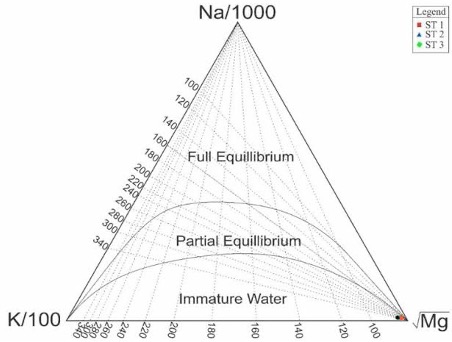
Energy needs have been increasing over time along with the increase in population and energy needs. Indonesia is one of the countries in the world that has enormous geothermal resource potential. This is because geologically, Indonesia is located in the Ring of Fire area, so it has the potential to produce geothermal energy, especially in North Sulawesi. This study aims to assess the geothermal potential in Sampiri Village, North Minahasa Regency. This study was conducted by analyzing fluid characteristics and estimating the temperature of the geothermal reservoir using geochemical methods and geothermometer calculations. The analysis was carried out through testing fluid samples in the laboratory, then data processing was carried out using Na-K and silica geothermometers and plotting a Na-K-Mg ternary diagram. The results of the analysis showed that the fluid type in Sampiri Village is immature water, indicating that the hot water in the study area has not reached equilibrium or has reacted with other elements on its way to the surface, with temperature estimation using a silica quartz geothermometer producing an estimated temperature of 250.1℃ - 261.2℃ indicating that this temperature is included in the high-type reservoir.
Article Details

This work is licensed under a Creative Commons Attribution-NonCommercial-ShareAlike 4.0 International License.
References
Ardelia, A., Pujiastuti, D., & Pohan, A. F. (2023). Identifikasi Karakteristik Fluida dan Estimasi Temperatur Reservoir Panas Bumi di Tanjung Raya dan Palupuh, Kabupaten Agam. Jurnal Fisika Unand, 12(3), 395–401. https://doi.org/10.25077/jfu.12.3.394-400.2023
Assa, M. M. V., & Isnawan, D. (2022). EVALUATION OF GEOTHERMAL RESERVOIR CONDITIONS BASED ON WELL PADS GEOCHEMICAL DATA IN LX GEOTHERMAL FIELD. KURVATEK, 7(1), 43–50. https://doi.org/10.33579/krvtk.v7i1.3133
Bai, Y., Shi, Z., Tong, J., Ye, H., Zhou, X., Wang, G., Liu, K., & Zhang, S. (2025). Mixing mechanisms control the hydrogeochemical composition in medium-low enthalpy geothermal areas. Geothermics, 128, 103270. https://doi.org/10.1016/j.geothermics.2025.103270
Bonita, D. P., Wihadanto, A., & Rusdiyanto, E. (2025). Analisis Keberlanjutan Pemanfaatan Energi Panas Bumi di Kawasan Pembangkit Listrik Tenaga Panas Bumi (PLTP) Ulumbu Nusa Tenggara Timur. SENTRI: Jurnal Riset Ilmiah, 4(11), 3372–3388. https://doi.org/10.55681/sentri.v4i11.4912
Buburanda, H., Ode, L., Sarif, M., Safiuddin, L. O., Aba, L., Halu, U., Kendari, O., & Sulawesi, P. (2024). Identifikasi Struktur Geologi Dasar Perairan Pulau Sulawesi Berdasarkan Interpretasi Data Geofisika. 2(2), 32–35.
Giggenbach, W. F. (1988). Geothermal solute equilibria. Derivation of Na-K-Mg-Ca geoindicators. Geochimica et Cosmochimica Acta, 52(12), 2749–2765. https://doi.org/10.1016/0016-7037(88)90143-3
Irmawati. (2021). Energi Panas Bumi di Indonesia. 1–9.
Jamlean, V., Bujung, C. A. N., & Rampengan, A. M. (2022). STUDI KIMIA FISIK FLUIDA PADA MANIFESTASI PANAS BUMI DANAU LINOW. Jurnal FisTa : Fisika Dan Terapannya, 3(2), 33–38. https://doi.org/10.53682/fista.v3i2.211
Li, Q., Hao, Y., Liu, C., Huang, J., & Yuan, X. (2024). Representative High-Temperature Hydrothermal Activities in the Himalaya Geothermal Belt (HGB): A Review and Future Perspectives. Water, 16(10), 1378. https://doi.org/10.3390/w16101378
Lontoh, T., Taunaumang, H., & Polii, J. (2022). ANALISIS KARAKTERISTIK FLUIDA DAN ESTIMASI TEMPERATUR RESERVOIR MENGGUNAKAN GEOINDIKATOR Na-K-Mg DI KECAMATAN TOMPASO BARU. Jurnal FisTa : Fisika Dan Terapannya, 3(2), 26–32. https://doi.org/10.53682/fista.v3i2.210
Mauliza, P., Yana, S., Susanti, S., Rahmi, R., Ikhbar, S., Maryam, M., & Syamsuddin, N. (2023). Kendala Pemenuhan Suplai dan Permintaan Energi Terbarukan Biomassa Indonesia. Jurnal Serambi Engineering, 8(3). https://doi.org/10.32672/jse.v8i3.6449
Permatasari, G., Sompotan, A. F., & Polii, J. (2024). Analisis Karakteristik Fluida dan Estimasi Temperatur Reservoir Desa Sawangan Kabupaten Minahasa Utara. Jurnal FisTa : Fisika Dan Terapannya, 5(2), 66–72. https://doi.org/10.53682/fista.v5i2.355
Primadanty, R. P. (2024). Potensi Biomassa Dalam Transisi Energi di Indonesia. PARAHYANGAN ECONOMIC DEVELOPMENT REVIEW, 2(2), 136–143. https://doi.org/10.26593/pedr.v2i2.7707
Rahayudin, Y., Kashiwaya, K., Tada, Y., Iskandar, I., Koike, K., Atmaja, R. W., & Herdianita, N. R. (2020). On the origin and evolution of geothermal fluids in the Patuha Geothermal Field, Indonesia based on geochemical and stable isotope data. Applied Geochemistry, 114, 104530. https://doi.org/10.1016/j.apgeochem.2020.104530
Rukait, R., Palilingan, R. N., & Polii, J. (2022). ANALISIS KARAKTERISTIK FLUIDA DAN ESTIMASI TEMPERATUR RESERVOIR DI DESA KARUMENGA KECAMATAN LANGOWAN UTARA. Jurnal FisTa : Fisika Dan Terapannya, 3(2), 8–11. https://doi.org/10.53682/fista.v3i2.208
Syuly Ratag, A., Bujung, C. A. N., Tumimomor, F. R., & Polii, J. (2022). ANALISIS TIPE FLUIDA MATA AIR PANAS BERDASARKAN DIAGRAM Cl-SO4-HCO3 DI DESA PINAESAAN KABUPATEN MINAHASA SELATAN. Jurnal FisTa : Fisika Dan Terapannya, 3(2), 1–7. https://doi.org/10.53682/fista.v3i2.206
Utami, Z. D., & Putra, A. (2018). Penentuan Karakteristik Fluida dan Estimasi Temperatur Reservoir Panas Bumi di Sekitar Gunung Talang. Jurnal Fisika Unand, 7(2), 130–137. https://doi.org/10.25077/jfu.7.2.130-137.2018
Zainal, P. A., Sutriyono, E., & Ibrahim, M. M. (2024). Perkiraan Temperatur Reservoir Panas Bumi Berdasarkan Metode Geotermometer Silika (SiO2) pada Daerah Danau Ranau dan Sekitarnya. Jurnal Penelitian Sains, 26(3), 376. https://doi.org/10.56064/jps.v26i3.1064